
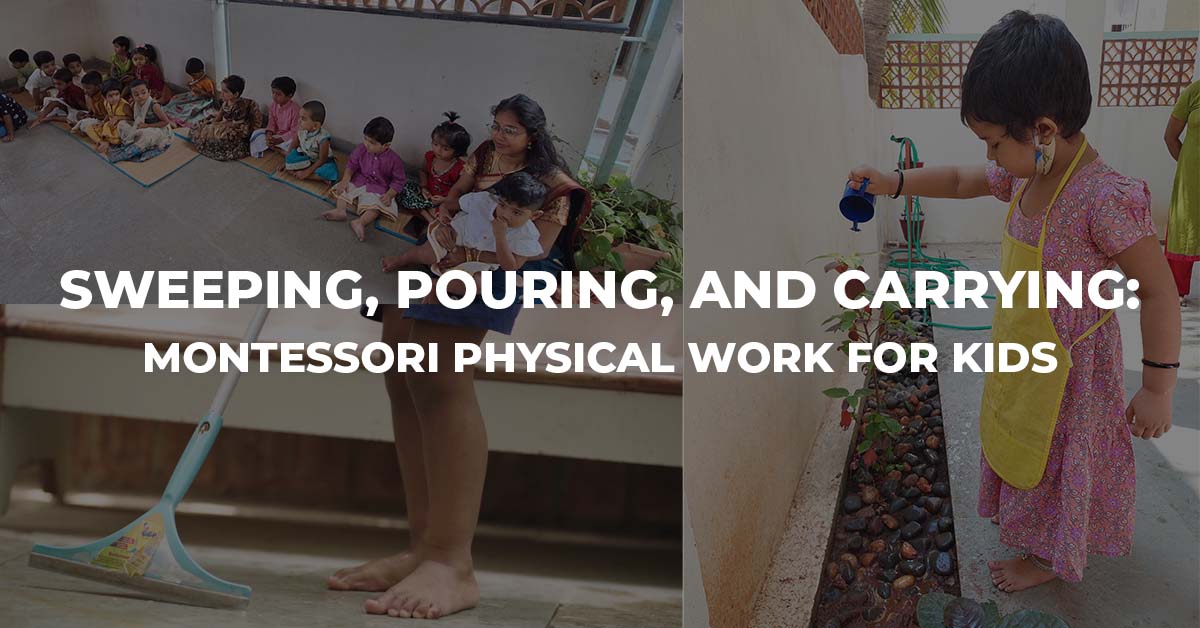
In a Montessori environment, even the most mundane of activities can be transformations for children. Sweeping the floor, pouring water and carrying objects may seem basic, but they actually have phenomenal educational purposes for kids. At best Montessori in Chennai, we are proud to offer these activities as part of “Practical Life” work.
We provide children experiences that help them build independence, concentration, and coordination, as well as prepare them for alternate and bigger tasks.
Sweeping: More Than Just Cleaning
When a child picks up a broom and goes to sweep, it is more than sweeping the floor. Sweeping involves hand-eye coordination, stability and attention. The child also learns to notice details, like “sweeping the crumbs into a pile” and builds an understanding of their role in keeping the space clean.
Sweeping practice also contributes to both gross and fine motor skill development, as children are practicing shoulder, arm and wrist control. In Montessori classrooms, sweeping is not about doing a chore; it is about caring for the environment and helping children become confident in what they do.
Pouring: Precision Through Practice
Pouring represents one of the most captivating activities for young children because it provides instant feedback. When children pour water from a jug into a cup, they must engage their two hands, control their physical movement and direct their attention.
If they experience a spillage, they practice trying again, while refining their motor coordination with a little more effort than in their first attempt. The process of developing their muscle control, patience and sense of independence occurs over time and many successes and failures.
Montessori educators often use dry materials such as rice or beans before presenting a liquid, so children can develop step-by-step skills. These small actions gradually strengthen the child’s grip, wrist movement and finger control, abilities that later support writing and other fine motor activities. All of these mini-exercises present a way to practice motor coordination while establishing their problem-solving skills as they learn to revise their attempts on every failure.
Carrying: Strength, Balance, and Care
It may appear simple to carry, but it is foundational to development in any Montessori learning opportunity. Moving objects with consideration should be encouraged; children will carry anything from lifting a chair to carrying a tray into their community.
By carrying, children learn to use their bodies and their respect for other people and objects. Carrying develops balance, builds strength and teaches spatial understanding. It fosters a sense of responsibility, as children begin to realize that their careful movements matter to the safety of the environment. Carrying supports the children in practical pursuits outside the classroom and provides a conceptual understanding of how to carry themselves confidently in different environments.
Why These Activities Matter
Children don’t sweep, pour or carry randomly; these tasks, or exercises, have a structure and connect active movement to cognitive development. Practical life work helps children have concentration, memory and problem-solving. Effective concentration and effort in an activity fosters a sense of order or a routine to follow, laying the foundation for discipline in a child’s own way and time.
Practical life work connects the home with the school. At the Montessori House, we understand children learn in many environments and want children to feel like what they do is valuable. Learning is aligned with real-life contributions, contributing to children’s self-esteem and allowing them to gain the confidence and responsibility to act independently in learning.
A Montessori Foundation for Life
These simple tasks are the foundation of lifelong skills. A child who learns to sweep develops coordination that makes writing possible. A child who learns to pour engages the same concentration and precision required for mathematics and the sciences.
Carrying things helps to build strength and awareness that are useful for anything from sports to day-to-day activities. Montessori education makes these associations and provides experiences where physical work is not separate from thinking: to be found in it.
Conclusion
In our Montessori house , activities like sweeping, pouring and carrying are seen as opportunities for a child to develop independence, coordination and confidence. By performing these activities independently, the child is learning to move in a thoughtful way and is, therefore, learning how to learn. And for families looking for an environment that values practical skills in addition to the whole child aspect of development, our play schools in Adambakkam make for a good start.