
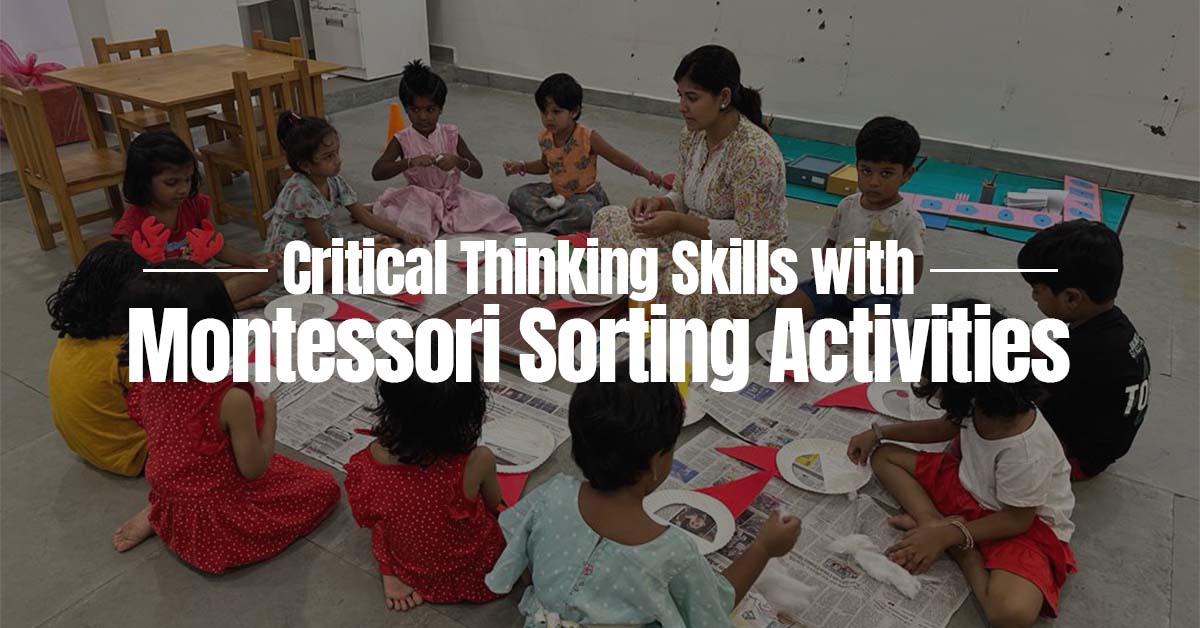
Critical thinking is much more than simply answering questions that are being asked , it is the behaviour of observing, comparing, analyzing and coming to rational conclusions. These abilities are foundational to problem solving in both academic contexts and daily life. However, for children, critical thinking does not start with abstract ideas.
It starts with simple, hands-on actions that encourage them to notice, make choices and think logically. Montessori Schools in Chennai employ sorting activities like sorting, matching, sequencing, and practical life exercises as a meaningful way to engage children in the development of thinking skills from the youngest ages.
Sorting as the First Step Toward Logical Thinking
Sorting is often the first introduced organized activity a child will encounter in a Montessori classroom. Sorting may seem like a simple task, but it is so much more than putting an object into a group. Every sorting activity helps the child train their mind to think logically.
When children are sorting buttons by color, beads by size or leaves by shape, they are practicing:
- Observation – carefully observing each object.
- Classification – putting objects into groups using obvious characteristics.
- Patterning – figuring out what is different and alike.
All of these are the beginnings, we call the roots of logical thinking. It takes time for the children to form sorting as a mental structure for how they will later think about mathematics, science and language. A child who learns sorting for recognizing patterns in a basket of shells will later come to recognize number patterns in arithmetic or patterns in the structure of words when reading.
More than Sorting: Matching and Sequencing
In addition to sorting, children in a Montessori classroom are encouraged to participate in matching activities. This includes things like matching picture cards to real objects or matching fabrics based on texture.
- Matching activities cultivate children’s developing ability to make connections and also work on strengthening memory.
- Sequencing activities are similar to matching activities as they involve putting things in order. Sequencing activities can be things like taking a set of rods and putting them in order from shortest to largest or following the order of cards of a story.
These activities help children learn about order and causation and the order of ideas. These skills are later extremely helpful for math concepts, reading comprehension, and scientific thinking.
Encouraging Independence in Decision-Making
A great strength of Montessori sorting is the opportunity for freedom of choice to sort. Children are not told to “sort only by size” or “sort only by color,” but they are invited to explore and decide for themselves how they want to classify objects.
This supports:
- Confidence- children learn to trust their decisions.
- Flexibility- children see where a given collection of objects can be grouped into several valid groupings.
- Ownership of learning- the child leads the learning, rather than a teacher imposing a sorting system.
The Montessori house guide stands by and observes without intruding, stepping in only when needed in support of the child’s process. With independent choices in a sorting context, children develop confidence in their judgment (arguably one of the most important building blocks of strong thinking).
Strengthening Focus and Attention to Detail
Sorting, sequencing number rods or choosing how to pour water in a practical life activity involves focus and precision. A child cannot effectively sort without slowing down and looking carefully at the object. In this way, sorting will teach children to:
- See small differences in shape, color or texture.
- Concentrate across an extended period of time without getting distracted.
- Build patience as things take effort and time.
For example, when a child sorts rice from lentils they practice a lot of focused attention and fine motor skills. Moreover, over time, these activities will develop their memory and advance the type of sustained attention they will need for reading comprehension, problem solving and future academic work.
Linking Sorting to Real-World Understanding
Montessori sorting activities are not abstract, they are purposefully connected to the child’s actual environment so that they understand sorting is not just a school activity but is understanding a part of their world.
Some examples include:
Sorting fruits and vegetables during snack prep.
Grouping shells, stones or leaves when exploring outdoors.
Classifying objects (wood, metal, fabric) to demonstrate most things in their daily lives are organized this way.
These connections give meaning to the activity. Children find out that classification is how scientists classify species, how mathematicians organize numbers and how society organizes information. It shows them that thinking, in this case, is a skill that they are practically using to navigate their daily life.
Extending Sorting into Academic Growth
Sorting, matching, and sequencing are important in Montessori education partially because sorting does have a long term function, even beyond early childhood. Sorting prepares a child for:
- Math: recognizing sets, sequences and patterns.
- Language: identifying types of words, letters and sounds.
- Science: identifying living and non-living things, materials and natural phenomena.
Montessori sort activities look innocuous. They are evidenced as a valuable way to influence the way children think. Through sorting, observation and problem solving, children are strengthening their thinking skills which will enable them to handle their academic and everyday life choices later on.
What starts as trays of buttons or leaves, will morph into the ability to reason through questions clearly and independently for the rest of their lives. For families who would like their child’s curiosity to be nourished and critical thinking to be cultivated, the Montessori house preschools in velachery provide a supportive setting to change the course of thinking, where every little step in a task can become a big step for growth.