
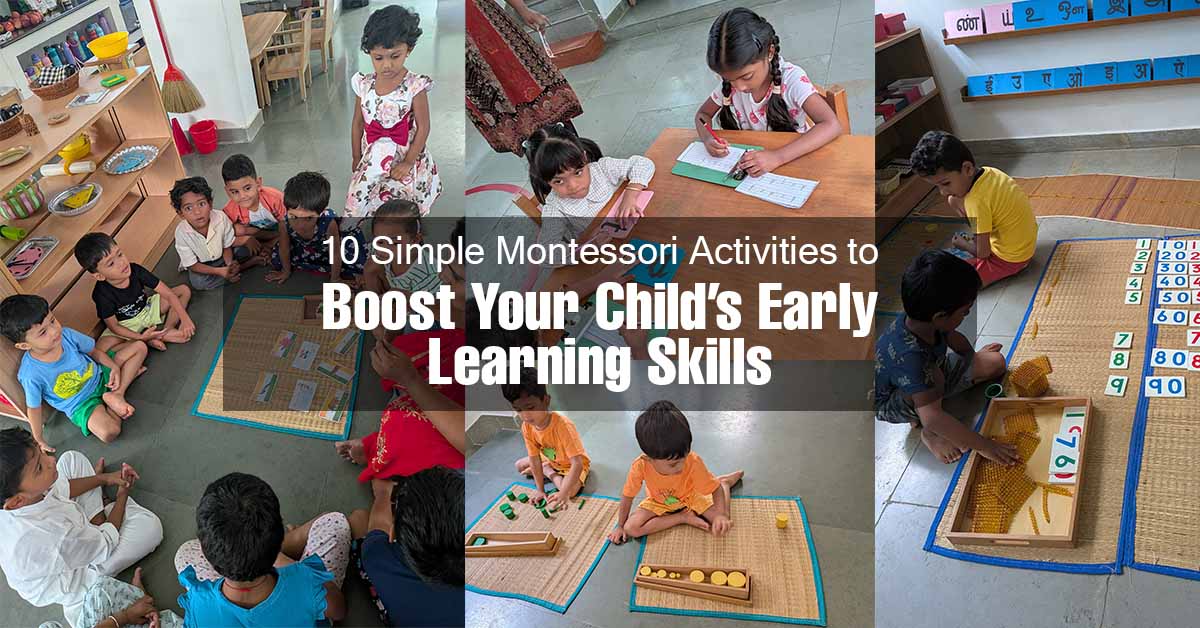
Children learn best when they are given the freedom to explore on their own. In the early years, real learning happens through hands-on experiences rather than constant instructions. The Montessori approach is built on this idea, allowing children to understand the world by doing tasks themselves, at their own pace. A lot of Montessori schools in Chennai implement this methodology to facilitate growth in a quiet and goal-oriented manner.
We explore ten simple Montessori activities that help children build the foundation of early learning while becoming independent, concentrating, and gaining self-assurance in this blog. The activities here can be modified quite easily and also represent the same learning principles practiced at The Montessori House.
How Montessori Activities Support Early Learning
Montessori learning is very deliberate. There is a definite purpose and a natural progression in every activity. Kids are not hurried or constantly corrected. On the contrary, they are allowed to do the same task over and over until they are personally gratified.
This method is aligned with the development of the first cognitive skills, and it is one through which children acquire virtues such as patience, attention, and problem-solving skills through authentic work instead of passive play.
1. Pouring and Transferring Activities
Pouring and transferring activities help children develop better control of their hands and improve hand-eye coordination. These simple movements encourage children to slow down, focus, and work with care.
One may present this work with:
- Little jugs and bowls
- Spoons or tongs
In addition, a tray keeps children from making a mess when they are working independently with dry materials like lentils or beans; thus, it promotes the development of their sense of responsibility.
2. Practical Life Cleaning Tasks
Kids love to get involved in activities that have a direct connection with their daily life. Easy cleaning tasks make them feel that they are able and that they have been given a certain level of trust.
Cleaning a table, dusting off a corner, or rinsing fruits are some of the things that children learn sequencing and order from. However, the most significant thing is that self-confidence is being developed. Young children start to realise that their deeds have an influence on the environment around them.
3. Sorting Activities with Everyday Objects
Sorting is a way for kids to recognize patterns and differences. This kind of activity is very helpful for the development of children’s logic and classification skills.
Use everyday items such as buttons, blocks, or simple objects found around the house. Start with one clear category, like colour or size, so children can sort comfortably without feeling confused. When the child grows more confident, you can slowly change the activity to make it still interesting but not too difficult.
4. Sound Matching for Developing Listening Skills
Listening is a very significant part of the first stage of education. Matching sound games contribute to kids’ development of their hearing senses. Sound boxes can be easily made by using rice, stones, or seeds. Encourage your child to listen carefully and match similar sounds. The main point here is concentration, not quickness.
5. Matching Objects to Real Images
One of the most effective ways of language development and visual memory is through matching picture cards with real objects. This activity is specifically effective with fruits, vegetables, animals, or vehicles.
Kids start to associate words with their real-world references, thus helping them to have a thorough language understanding instead of just memorising.
6. Sensory Exploration with Natural Materials
Sensory learning is not a very complicated process. It requires natural objects which can provide a wide range of sensory experiences and that can contribute to the growth of the brain.
Children learn a lot through sensory play using simple materials such as:
- Sand and water
- Wooden objects
- Fabrics with different textures
Let them explore freely. Observation matters more than instruction at this stage.
7. Montessori Puzzles with a Defined Goal
Montessori puzzles concentrate on a single idea or concept. For instance, a shape puzzle helps the child to develop spatial awareness, whereas a knob puzzle is aimed at increasing the child’s grip and control.
When children struggle a little, resist the urge to help right away. That small challenge lets them solve problems on their own and builds self-confidence.
8. Language Learning Through Daily Conversations
Language is best developed through genuine communication. Daily habits such as cooking or dressing provide very natural opportunities for talking.
Illustrate the actions in a clear and slow manner. Pose easy questions and wait for answers. Such moments help vocabulary expansion in a very effective way.
9. Movement-Based Learning Activities
Movement is essential to the early stages of life. The body and world are understood by kids through such plays as carrying things, walking on a line, or climbing.
These experiences contribute to:
- Balance and coordination
- Focus and self-regulation
- Confidence in physical movement
Kids who are allowed to move as they wish are, in most cases, more capable of focusing on quiet tasks.
10. Encouraging Independent Choice
Preparing a small shelf with a handful of carefully selected activities gives children an opportunity to make independent choices. In this way, they develop their sense of accountability as well as their decision-making skills.
Kids are taught to start, finish, and put away activities by themselves. Such a system is a close approximation of the operation of Montessori classrooms.
Bringing Montessori Learning into Everyday Life
You don’t need expensive materials or a perfect setup to use the Montessori method. Even a single, well-planned activity can make a big difference. When the values of home and school match, kids become emotionally stable and have a high level of self-esteem. Therefore, parents searching for the best Montessori schools in Velachery usually want the kind of settings which, from the very first years of a child’s life, are able to give the child freedom and self-reliance.
The Montessori House is a place where learning revolves around the concepts of trust, respect, and engagement in a purposeful activity. The Montessori method is not about doing more; it is basically about giving children the opportunity to mature through relevant and purposeful tasks on a daily basis.