
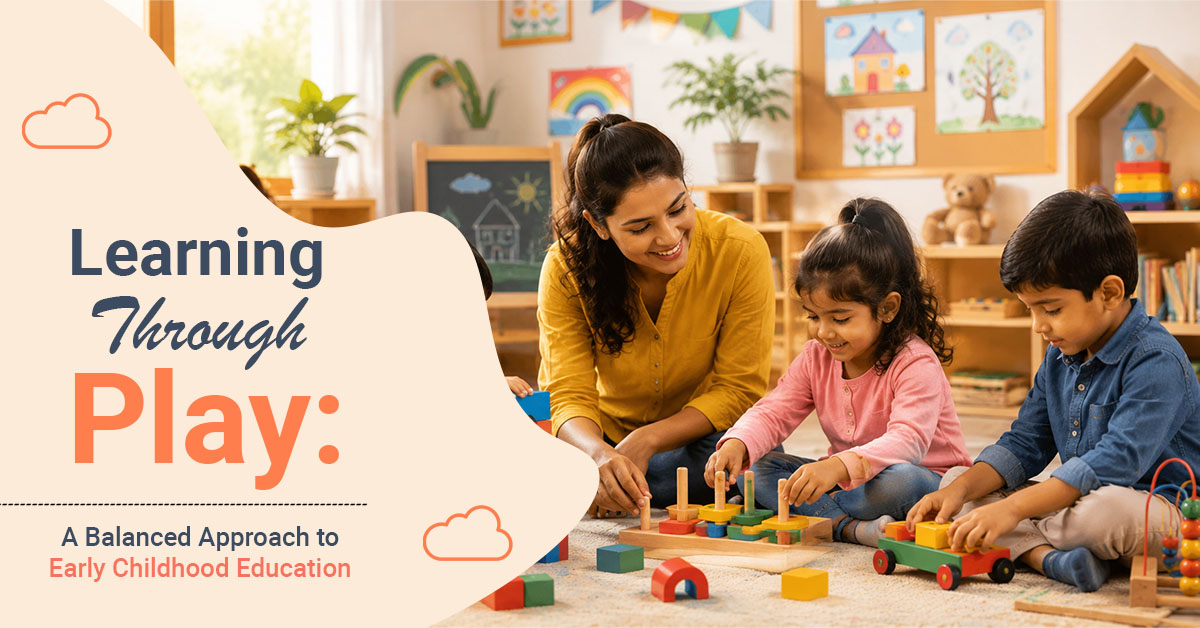
Watch a three-year-old arrange coloured beads on a tray. She isn’t following instructions. Nobody told her to sort by colour or line them up smallest to largest. She just did it. That quiet, self-directed concentration is what play-based learning looks like in practice, and it is far more purposeful than it appears. For families exploring Montessori schools in Chennai, understanding this approach is often the first step toward finding the right fit for their child.
What Is Play-Based Learning?
Play-based learning is the understanding that young children absorb knowledge most deeply when they are genuinely engaged: moving, choosing, creating, and exploring, rather than sitting still and receiving information. Between the ages of 1.5 and 6, a child’s brain is wired for this kind of active discovery. The Montessori method is built entirely around this truth.
This doesn’t mean anything goes. Play-based learning in a well-prepared environment is purposeful. Every material on the shelf, every activity on the mat, every moment of free movement is designed to meet children where they are developmentally and gently stretch them forward. The difference from conventional schooling is that the child leads, and the environment responds. A child who chooses to work with the same material three days in a row is not being repetitive. They are deepening understanding in a way that no amount of instruction can replicate.
Why Balance Matters in a Preschool Curriculum
Many parents arrive at Montessori schools with a version of this question: “But will my child actually learn anything?” It’s a fair question, and the answer is yes, but not in the way most people expect.
A good balanced curriculum for preschool doesn’t sit at either extreme. Free exploration without any structure can leave gaps in development. A rigid academic programme pushed too early can create anxiety and kill curiosity before a child ever reaches primary school. Research in early childhood development consistently supports this: children who are rushed into formal academics before they are ready often struggle more in later years, not less. The Montessori approach sits deliberately in the middle, offering a balanced curriculum for preschool that combines freedom with genuine purpose.
What that looks like on a typical morning:
- Practical life work: pouring, folding, spooning; tasks that build concentration and fine motor control
- Sensorial exploration: materials designed to isolate one quality at a time, sharpening a child’s ability to observe and compare
- Language work: sandpaper letters, object-word matching, storytelling, conversation
- Early mathematics: concrete bead materials, number rods, counting that a child can hold in their hands
- Outdoor and free play: unstructured time where children follow their own curiosity and social instincts
None of these happen in isolation. They weave together across the morning. A child who has spent twenty minutes pouring water with focus is better prepared to sit with a language activity than one who has never had to attend to a task. That is the logic of a balanced curriculum for preschool: everything builds on everything else, and every part of the day is doing more than it looks like it is doing.
Examples of Play-Based Learning Activities
The best way to understand this approach is to see it. Here are some common examples of play-based learning activities you would find in a Montessori environment:
1. Practical Life: Spooning and Pouring
A child transfers dried beans from one bowl to another using a spoon, then pours water between two small pitchers. The spill is part of it. So is wiping it up. This activity builds hand-eye coordination, concentration, and a quiet sense of competence, all before any academic work begins.
2. Sensorial Work: The Pink Tower
Ten wooden cubes, each different in size. The child builds them from largest to smallest, then dismantles and repeats. There is no worksheet, no correct answer to circle. The material itself tells the child when something is wrong. This is one of the most recognisable examples of play-based learning activities in Montessori classrooms, and its purpose runs deeper than it looks. It lays the groundwork for understanding dimension, order, and mathematical relationships.
3. Sandpaper Letters
A child traces a letter cut in sandpaper while a guide says the sound. Touch, sight, and sound work together. Children who struggle with written letters on paper often find that this tactile approach unlocks something that instruction alone couldn’t reach.
4. Dramatic and Role Play
Children recreate domestic scenes, take on roles, and negotiate who plays what. The social and language learning packed into thirty minutes of unscripted role play outpaces most structured group lessons at this age. It also gives children a safe space to process experiences from their world outside school.
5. Nature Exploration
Bringing the outside in through leaves, stones, seeds, and insects, or taking children out to observe and collect. Sorting natural objects by texture, size, or colour is one of the most natural examples of play-based learning activities there is. It connects children to the world beyond the classroom and sharpens the same classification skills that formal science will later rely on.
6. Story-Based Math
Rather than worksheets, a teacher uses a simple story: “There were five birds on a branch. Two flew away. How many stayed?” Children act it out, count on their fingers, reach for objects. The concept moves from abstract to real, and it sticks.
What to Look for When Choosing a Preschool
Not every school that uses the word “play-based” actually delivers it. When visiting, look past the brochure and pay attention to what is actually happening in the room:
- Are materials accessible to children, or locked away and brought out only during designated times?
- Do teachers observe and ask questions, or mostly direct and correct?
- Is there a predictable rhythm to the day without being rigid?
- Do children look purposeful, even when they are moving around freely?
- Is outdoor time built into the programme, or treated as a reward for finishing work?
- How is progress tracked? Portfolios and observation notes suggest a school that actually watches each child. Test scores alone suggest the opposite.
The answers to these questions show up in the room before anyone says a word.
The Role of Home
A child’s learning doesn’t stop at the school gate. Parents who extend play-based learning at home, even in small ways, see the effects compound quickly. This doesn’t require Montessori materials or elaborate setups. Let a child pour their own water at breakfast. Give them a small, real task in the kitchen. Resist the urge to solve the problem before they have had a genuine chance to try it. When they ask a question, explore it together rather than just answering it.
These moments, repeated daily, build the same independence and focus that a prepared classroom is designed to nurture. The consistency between home and school is often what separates children who thrive in a Montessori environment from those who take longer to settle.
Finding the Right Fit in Chennai
For families in Chennai considering this approach, spending time inside a real Montessori classroom is the single most useful thing you can do. Descriptions only go so far. Preschools in Velachery and across the city vary widely in how faithfully they apply child-centred principles, so a visit matters more than a ranking or a recommendation.
Play-based learning isn’t a soft option or a compromise on academic readiness. For children under six, it is the most effective way to build the foundation that everything else rests on: focus, confidence, curiosity, and a genuine appetite for the hard work of learning. The child who spends her preschool years building, sorting, pouring, and exploring isn’t falling behind. She is building exactly what she needs for everything that comes next.