
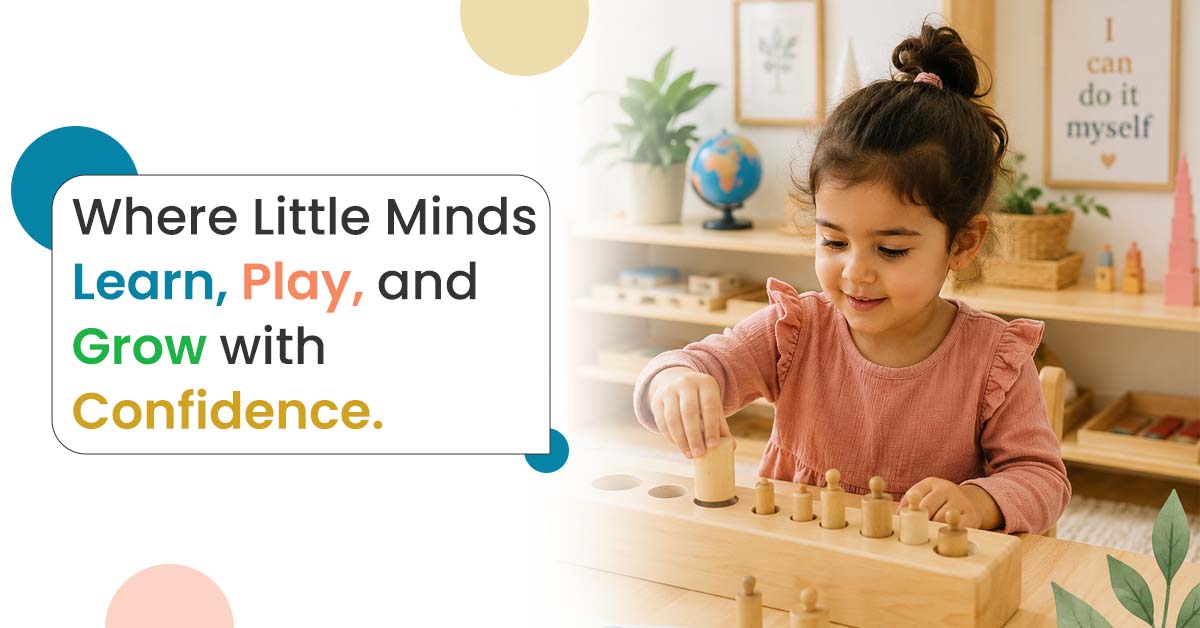
Every parent knows the look: their child figuring something out alone, glancing up with quiet, unhurried pride that no praise could produce. It’s not a big moment, but it stays with you because you know something real just happened. That kind of confidence doesn’t come from being told you’re capable. It grows when a child is given the right environment, one where early childhood learning feels like discovery rather than instruction and where trying and failing are both part of the process. That’s what we set out to build at The Montessori House, one of the most trusted Montessori schools in Chennai for children aged 1.5 to 6 years.
The early years, roughly from 18 months to 6 years, are when children absorb more than at almost any other point in their lives. Early childhood learning during this window shapes not just what they know, but how they feel about learning itself. Get it right, and you raise a child who approaches new challenges with curiosity. Rushed or pressured, and even the most capable child can start to second-guess themselves before they’ve had a chance to begin.
Why Confidence Is a Skill, Not a Personality Trait
A lot of parents assume confidence is something a child either has or doesn’t. That’s not quite right. Confidence is built, piece by piece, through small daily experiences of doing something, getting better at it, and knowing that you did it yourself.
This is why confidence building activities in the early years matter so much. When a two-year-old pours water into a cup without spilling, they’re not just practising a motor skill. They’re learning that effort leads somewhere. When a four-year-old figures out how a puzzle fits together without being told the answer, they’re building the belief that they can solve things. These aren’t big dramatic moments. They’re quiet ones. But they stack up.
At The Montessori House, we design the entire environment around this idea. Every material a child reaches for, every task they take on, is calibrated so that the challenge is real but the child is ready for it. That balance is where confidence grows.
What Child Development Skills Actually Look Like in Practice
Child development skills aren’t a list of milestones to tick off. They’re a web of abilities that grow together, each one supporting the others.
Here’s what that looks like across the key areas we focus on:
Language and Communication
- Children build vocabulary through real conversation, not repetition drills
- Storytelling, listening, and asking questions are woven into daily activity
- We work across Tamil, Hindi, and English so language feels natural, not academic
Fine and Gross Motor Development
- Practical life activities like pouring, buttoning, and carrying build hand-eye coordination
- Movement is part of the day, not a break from it
- Children develop body awareness and control through purposeful tasks
Social and Emotional Learning
- Children learn to share, disagree, and listen by actually doing it alongside others
- They care for shared spaces, which builds a quiet sense of responsibility
- Empathy grows through daily interaction, not lessons about empathy
Cognitive and Problem-Solving Skills
- Montessori materials are self-correcting, so children discover mistakes on their own
- Sequencing, sorting, and categorising happen through hands-on exploration
- Focus develops naturally when children choose work that genuinely interests them
Independence and Decision-Making
- Children make real choices throughout the day
- They learn to begin tasks, see them through, and put things away
- This builds the kind of self-direction that stays with them well beyond preschool
None of these are taught in isolation. They come together through the rhythm of a Montessori day.
How the Environment Does Much of the Work
Walk into our classroom and you’ll notice something: it’s calm. Not quiet in a rigid, don’t-move way. Calm in the way a well-organised space feels when everyone in it knows what they’re doing.
That’s intentional. The prepared environment is one of the most important ideas in Montessori education. A Every shelf is at child height. Every material has a place. Every activity is accessible without asking for help. Children move freely, choose their work, and settle into it.
This setup does something important for early childhood learning: it removes the friction between a child and what they want to learn. There’s no waiting to be picked. No sitting still while someone else has a turn. Each child is in their own rhythm, working at their own pace, with a guide nearby who observes rather than directs.
Our educators don’t hover. They watch, notice what a child is drawn to, and introduce the next thing at the right moment. This kind of attentive guidance, without interference, is what lets children build genuine independence rather than learned helplessness.
Confidence Building Activities in a Montessori Day
The confidence building activities in our environment aren’t labelled as such. They’re just the normal work of the day. But every one of them is doing something specific.
| Activity | What It Builds |
| Practical life tasks (pouring, folding, sweeping) | Fine motor control, focus, self-reliance |
| Sensorial materials (colour tablets, sound boxes) | Observation, classification, patience |
| Sandpaper letters and moveable alphabet | Pre-writing, phonics, language confidence |
| Number rods and bead chains | Early numeracy, sequencing, logical thinking |
| Group work and circle time | Listening, turn-taking, social awareness |
| Food preparation activities | Sequencing, responsibility, real-world skills |
What all of these share is that the child does the work. The guide sets the stage, demonstrates once, and then steps back. The satisfaction a child feels when they complete something real is different from the satisfaction of being told they did well. One comes from outside. The other comes from within.
The Toddler Years: Getting the Foundation Right
Children who join us between 18 months and 2.5 years are in one of the most sensitive periods of their development. Everything is new. Their brains are making connections at a rate that won’t happen again.
In our Toddler programme, the focus is on security and gentle structure. When a child feels safe, they explore. When they explore, they learn. Activities are simple, sensory-rich, and repetitive in the best way. Because repetition at this age isn’t boredom, it’s mastery.
By the time they move into the Primary environment, they’ve already built a relationship with the idea that learning feels good. That’s the real foundation.
The Primary Years: Where It All Comes Together
Between 2.5 and 6 years, children in our Primary programme take on more complex work. The child development skills they built as toddlers now carry them forward into language, early mathematics, cultural learning, and increasingly sophisticated social interaction. Watching these child development skills come together in one child over two or three years is something our guides never take for granted.
This is also where we see the most visible growth in confidence. Children who’ve spent time in a Montessori environment at this stage tend to ask more questions, persist longer with challenges, and show a comfort with not knowing the answer yet. They’ve learned that not knowing yet is just the beginning.
Giving Your Child the Right Start
The early years don’t come back. What children experience between 18 months and 6 years quietly shapes how they think, how they relate to others, and how they feel about their own abilities. An environment that respects this, one that gives children real work, real choices, and real trust, does more than just teach them things. It shapes who they become.
We built The Montessori House around exactly these principles. We’ve seen what happens when children are given real trust in those first years. If you’re searching for preschools in Velachery or Madipakkam for your child, come visit us. See the space, meet our guides, and watch how the children work. That’ll tell you more than any brochure can.