
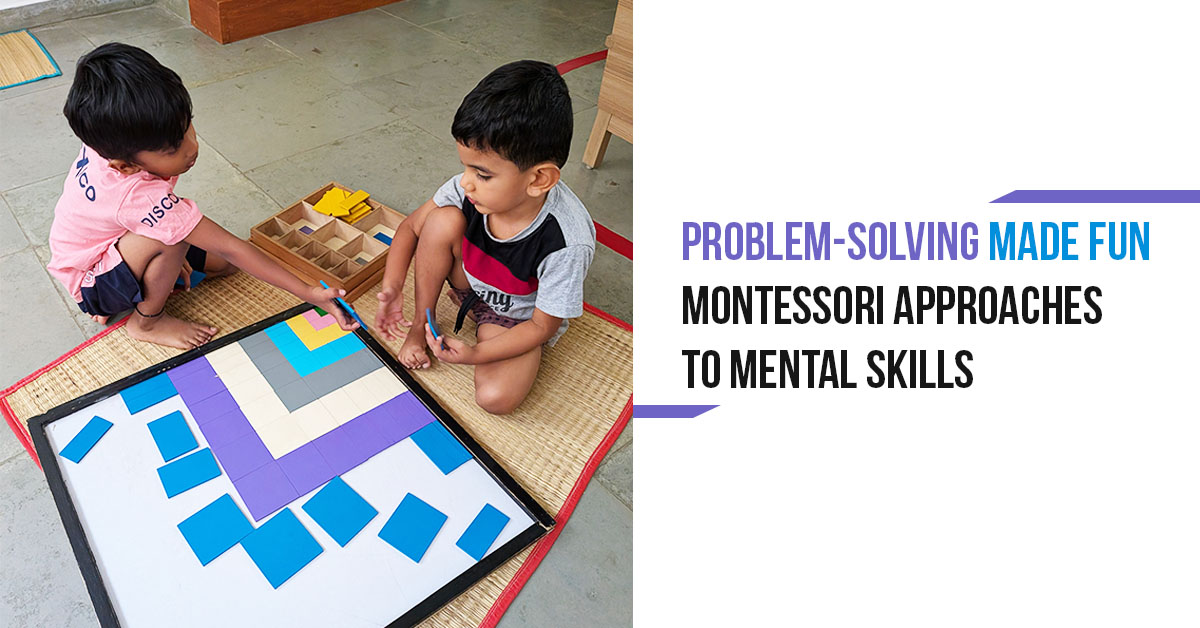
Each kid comes to this world with innate curiosity, but turning that natural inquisitiveness into organized problem-solving skills needs some coaching and exercises. At the Montessori Schools in Chennai, the emphasis is on developing thinking skills in a fun, engaging, and very effective manner. The children, through the carefully planned activities, learn to observe, analyze and decide on their own, thus, they are required to have a strong foundation for cognitive growth throughout their lives.
Montessori problem-solving is not seen as a task to be accomplished by force but rather as an explorative journey. Activities are prepared to challenge the children just the right amount to encourage them to use their minds without causing them to get frustrated. Such activities not only help to build self-confidence in children but also impart a sense of enjoyment in acquiring knowledge which lasts long after the kids have left the classroom.
In this blog we will look at few fun activities that helps the kids to develop their Mental Skills
Puzzle-Based Activities
Puzzles involve kids to figure out through trial and error, thus developing the trait of persistence, reasoning, and logical sequencing.
- Geometric was to develop spatial understanding
- Sequencing cards to learn order and predict outcomes
- Tangrams and jigsaw puzzles to strengthen problem-solving and visual thinking
Upon completion, children can instantly see whether their puzzle solution is correct, which helps them to change their strategies on their own if they are incorrect
Sorting and Categorization
The sorting and categorization activities represent one of the most powerful tools in Montessori classrooms. Kids, who are sorting objects by shape, color or size, learn to recognize patterns, to use the organizational type of thinking and to show their attention to detail.
- Sorting beads or blocks by color, size or shape
- Categorizing natural objects such as leaves, stones or shells
- Matching objects based on function, for example, kitchen tools or toy animals
These exercises may look simple, however, they engage children to compare, analyze and make choices, which are the basic elements of critical thinking independently. This feeling of success nurtures both the self-confidence and the analytical thinking skills.
Practical Life Exercises
Practical life exercises in the Montessori method might be seen as common daily chores; however, they are developed to improve the child’s decision-making, concentration and fine motor skills significantly.
- Pouring water or grains from one container to another to improve hand-eye coordination
- Folding clothes to enhance planning and organizational skills
- Threading beads or tying shoelaces to develop patience and concentration
The kids are required to consider the sequence of steps, predict the outcomes and correct their errors, the skills that facilitate them to solve problems when they are out of their imaginary world.
Language and Storytelling
Language activities are very good for children’s cognitive development as they involve abstract thinking and logical reasoning.
- Making up stories using picture cards to grasp sequence and narrative structure
- Analyzing descriptions of the classroom environment to develop analytical thinking
- Playing role-playing games that empower participants to come up with solutions for pretend problems
Language exercises not only help kids to speak their minds clearly but also enhance their skills to explain, evaluate and reflect on their problem-solving approaches.
Self-Directed Exploration and Collaboration
The exercise of autonomy and collaboration form an important part of the Montessori system of problem-solving. Kiddos are allowed to pick up activities at their will which is a good way to nurture intrinsic motivation and independent thinking. Through group activities, children can work out the responsibilities, share ideas and collaborate towards achieving common goals.
- Experimentation chosen by oneself with building blocks or natural materials
- Collaborative projects where kids work together to find solutions to challenges
- Peer discussions to reflect on the strategies and the results
Children get the necessary tools for facing new situations with confidence through these methods. They learn to carefully observe, come up with hypotheses, put their ideas into practice, and change accordingly.
Developing thinking skills has been the core thing around which education at The Montessori House revolves. The interactive activities, personal initiative exploration, and group learning turn problem-solving into an engaging, confidence-enhancing, and cheerful practice of the daily pedagogical process.
For parents aiming for true intellectual development in their kids, a startup such as Play Schools in Pallikaranai like The Montessori House is the right choice. It is a place where one’s intelligence and creativity not just grow but also enhance. This method works wonders in the education field by incorporating problem-solving skills in playful, yet purposeful activities for kids. The kids not only gain extensive skills that they can use outside the classroom as well but are also being groomed to become thinkers, inventors, and lifelong learners.