
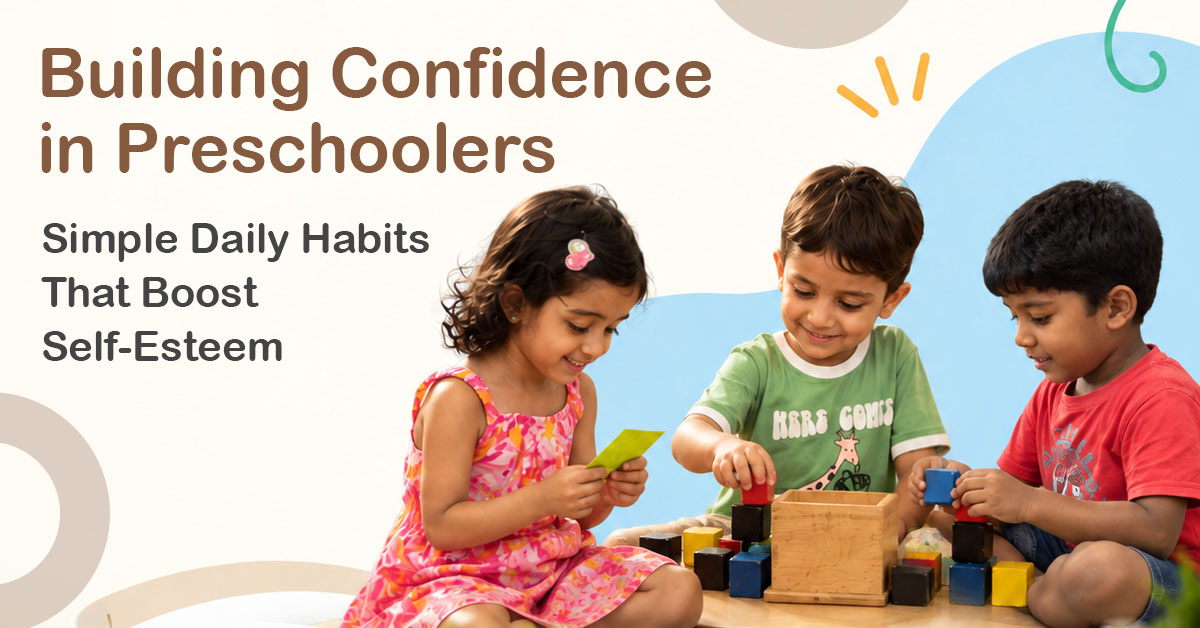
A preschooler’s confidence doesn’t just appear one morning. It’s built in pieces, through the small stuff, tiny wins, a bit of patience from the adults around them, and enough room to attempt things without someone always stepping in. Parents researching Montessori Schools in Chennai tend to circle back to one question again and again: how do you raise a child who trusts themselves without making every waking hour feel like a lesson? Turns out, it’s rarely about big moments. It’s the ordinary ones that count. A child pouring their own glass of water. A kid wrestling with a zipper for a minute before anyone jumps in. Hearing “you worked that out” instead of a flat “good job.” These little things carry more weight than they seem to. In this blog, we will take a closer look at how everyday routines shape a preschooler’s self-worth and what parents and teachers can actually do to support it.
Why This Age Matters So Much
Somewhere between three and six, kids start building their first real ideas about who they are and what they can do. That’s not something to hurry through. It’s the groundwork. Some child psychologists talk about this stretch as the time a child’s inner voice starts to form, one that either leans toward “I can” or drifts toward “I can’t.” Whatever pattern takes hold at home or in the classroom during these years has a way of sticking.
Confidence here rarely looks flashy. It’s not a child performing for an audience. More often, it’s a toddler trying to button their own shirt before calling for help or raising a hand in class despite not being fully sure of the answer. These moments look small from the outside. They aren’t.
Give Them Real Responsibility, Not Busywork
There’s a difference between assigning a task and actually trusting a child with something. When a preschooler is handed a real responsibility, watering the plants, setting their own plate, feeding a pet, they begin to see themselves as someone who contributes, not just someone who’s managed.
Keep it small at first, and let go of the need for a perfect outcome. A spilled cup or a slightly crooked plate isn’t something to fix immediately. What actually matters is that the child did it on their own and felt that quiet sense of having pulled it off.
A few things that tend to work well at this age:
- Letting them choose their own clothes, mismatched colors included
- Having them sort laundry into lights and darks
- Giving them a small job while cooking, tearing lettuce, stirring, that kind of thing
None of it requires constant hovering. Stepping back for even a short while tells a child their ability is trusted.
Praise How They Worked, Not Just What They Got
Plenty of caring adults default to words like “smart” or “talented.” It feels encouraging in the moment. But some research on early development suggests this kind of praise can actually backfire, making kids more cautious about trying difficult things later, out of fear they’ll lose that label if they don’t succeed.
A better habit is praising the effort itself. Rather than “you’re so smart,” something like “I noticed you kept going even when that puzzle piece wouldn’t fit” works better. That small change in wording shifts how a child sees themselves, from being naturally good at something to being someone who pushes through when things get hard. That mindset tends to outlast any single compliment by a long way.
Don’t Rush to Fix Every Mistake
It’s an almost automatic reflex to jump in the moment a child struggles. A tower of blocks wobbles, and a hand shoots out before it even topples. That instinct comes from a good place, but it quietly takes away the child’s chance to work through the problem on their own.
At this age, mistakes aren’t failures. They’re just information. A child who spills milk while pouring learns something about balance that no explanation could teach half as well. When adults hold back, even briefly, children start relying on their own judgment a little more each time.
That’s not to say ignore real danger or genuine distress, of course. It just means giving a beat of space before stepping in, so the child gets a shot at solving it themselves first.
Predictable Routines Give Them a Sense of Control
Preschoolers tend to do better with routine. A consistent morning, waking up, getting dressed, eating, brushing teeth gives a child a kind of mental map for what comes next. That predictability lowers anxiety and frees up energy for other things, like curiosity, like actual play.
Where it makes sense, involve the child in shaping that routine. Something as simple as a picture chart on the wall can turn a chaotic morning into something the child feels some ownership over. Even a small say in how the day unfolds reinforces the belief that they can handle it.
Let Them Play Without Direction
Not every moment needs a purpose or a lesson attached to it, and honestly, some shouldn’t. Unstructured play, blocks, crayons, a bucket of sand, teaches decision-making without any real stakes attached. No correct answer. No adult evaluating the result. Just a child figuring things out at their own pace.
This kind of play also builds tolerance for boredom, which feels rarer by the year in a world full of constant stimulation. A child who learns to occupy themselves, even briefly, ends up with a kind of resourcefulness that carries into nearly everything else they do.
Show Them What Confidence Looks Like
Children notice far more than most adults assume. They watch how the people around them deal with setbacks, talk about themselves, react when something goes wrong. A parent who says out loud, “I got that wrong, let me try again,” teaches something no pep talk ever could.
Try to avoid harsh self-criticism in front of young kids, even as a joke. Comments like “I’m terrible at this” or “I can never get it right” register more than people think. Preschoolers pick up on tone long before they understand the actual words.
Small Moments of Recognition Go Further Than Big Ones
Not every accomplishment calls for celebration. Overpraising small actions can water it down, and oddly enough, can make children lean more on outside approval instead of feeling good about their own work. A simple nod, a sincere “you did that yourself,” or just letting a child show off their work without adding commentary can be enough on its own.
The goal is helping kids notice their own progress, rather than depending entirely on adult reaction to feel good about what they’ve done.
At The Montessori House, we see these small, everyday habits shape children’s confidence all the time, it’s something we watch unfold in our classrooms daily. What we’ve built here reflects the same ideas discussed above, real responsibility, space to get things wrong, and routines steady enough that independence has room to grow. We don’t believe self-esteem comes from worksheets or star charts. It grows out of daily practice, patience, and simply being given the chance to try.
If you’re looking into Playschools in Velachery,, come see this approach for yourself. It goes beyond simply getting a child ready for school. What it really builds is a quiet, steady confidence that stays with them for years to come. Feel free to reach out to our team at The Montessori House if you’d like to learn more or set up a visit.