
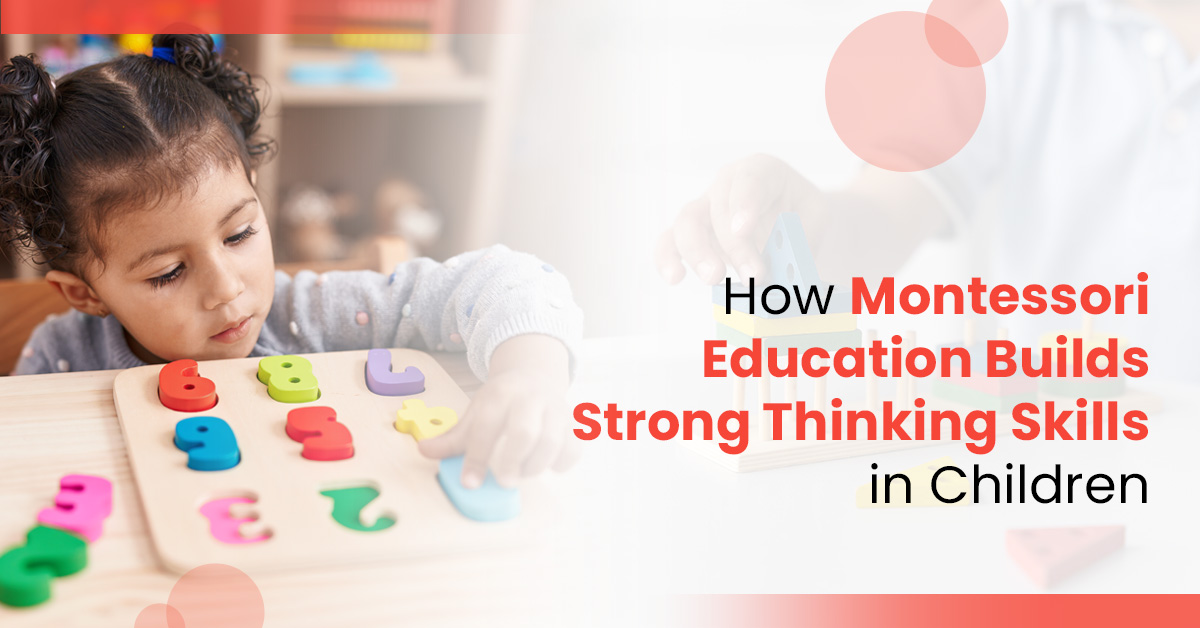
Watch a four-year-old pour water from a glass pitcher. They misjudge the angle. Water spills across the wooden table and drips onto the floor. A traditional classroom usually involves an adult intervening immediately to clean up the mess to save time. In our classrooms, the response changes entirely. The child spots the puddle. They walk to the supply shelf, get a cloth, and clean the wood. Developing a critical thinking skill begins right here in these quiet physical actions. We often hear parents touring a preschool in Madipakkam question whether room design truly alters a child’s thought process. It absolutely does. Using Montessori learning methods removes the adult from the center of the room. The physical space forces the child to act.
The Environment Demands Choice
Every morning, children walk into the classroom and decide what to do. No bells signal a change in subjects. A child might pick up a set of counting beads. Another might choose to wash a small window. A third child might sit quietly and watch the others work.
The materials on the shelves are carefully curated. When children select their own work, they evaluate options. This daily decision-making forms the absolute foundation for developing problem-solving skills in kids. Sometimes they pick a complex puzzle. They struggle with it for ten minutes. They eventually put it back and try something else. That self-assessment is necessary for cognitive growth. You cannot teach a critical thinking skill through worksheets alone. It requires daily practice in making choices and dealing with the physical results of those decisions.
Real-World Tasks Create Logical Thinkers
You see young children chopping bananas or washing small cloths in these environments. These are not just activities to keep them busy. They are deliberate exercises in sequencing. A child cannot slice a banana without first peeling it. They cannot wash a cloth without getting water in the basin.
They learn that a specific order of operations produces a desired result. Skipping a step means the task fails. This physical logic translates directly to mental logic later on. They practice breaking a larger goal down into manageable steps.
Making Mistakes is Part of the Process
Look at the wooden cylinder blocks found in these rooms. A child tries to put a wide cylinder into a narrow hole. It does not fit. An adult does not need to point out the error. The physical object provides the feedback.
We rely on this physical feedback loop constantly when applying Montessori learning methods. A child learns to trust what their hands and eyes tell them. They try something. They watch it fail. They try a different angle. That tolerance for minor failures is exactly what builds problem-solving skills in kids. Watch a child working with the ten wooden cubes we call the Pink Tower. They stack them from largest to smallest. A heavy block goes on top of a smaller one. The whole thing tips over and crashes to the floor. No adult steps in to correct them. Gravity does the teaching. The child simply picks up the blocks and pays closer attention to the sizes the next time around.
Observation Replaces Direct Instruction
The teacher acts as a guide rather than a lecturer. They watch closely. A child struggles to complete a wooden puzzle map. A traditional teacher might point to the exact spot where the piece belongs. A Montessori educator waits.
They observe the child’s frustration level. They might ask a simple question about the shape of the piece instead of providing the answer. This restraint is difficult for adults. We want to help. Withholding the immediate solution forces the child to analyze the situation again. They have to rely on their own visual discrimination.
Time and Uninterrupted Focus
Standard schedules slice the day into rigid blocks. The alternative uses a three-hour uninterrupted work cycle. Children get deeply involved in complex tasks without arbitrary interruptions.
A five-year-old might spend two hours building a map of the continents. They encounter spatial challenges. They figure out how the odd shapes fit together on the paper. Having the time to sit with a difficult task allows a child to work through frustration. They hit a wall. They sit there and look at the problem. They eventually figure out a workaround. Fostering a critical thinking skill requires this kind of extended time. Deep thought requires a quiet mind and a clock that is not ticking loudly in the background.
Social Dynamics in Mixed-Age Classrooms
These classrooms group three, four, and five-year-olds together. This structure changes the social dynamic entirely. A younger child struggles to tie an apron. An older child walks over, shows them the steps, and leaves. The teacher stays out of it.
Explaining a concept forces you to break it down logically. This environment naturally enhances problem-solving skills in kids because conflicts are resolved interpersonally. Two children might want the exact same set of building blocks. They negotiate. They figure out how to share the physical space. Children learn to calculate the best approach to get what they want fairly.
Working with the Hands Develops the Mind
Math is notoriously difficult to teach abstractly. Young children struggle with numbers they cannot physically hold.Montessori learning methods introduce mathematical operations through physical glass beads and wooden cubes. A child physically carries a unit of ten from one column to the next. The concept of quantity becomes a physical reality.
Physical manipulation precedes mental calculation. The hands train the brain. They are applying a tested critical thinking skill to abstract numbers. We see children transition from needing physical beads to doing the math in their heads over several months. The learning is rooted in sensory input.
Conclusion
Building cognitive independence is deliberate. It happens when children interact with a structured physical reality on their own terms.Montessori learning methods provide the framework for this interaction. The environment asks children to make decisions early in life. The objective is to cultivate adaptable minds capable of logical analysis. Developing strong problem-solving skills in kids requires adults to step back. We have to let them struggle a little bit. Parents evaluating the best Montessori schools in Chennai often realize this is the hardest shift to make at home. They need to spill the water and figure out how to clean the mess up. Those quiet moments build their capacity to think clearly as adults.