
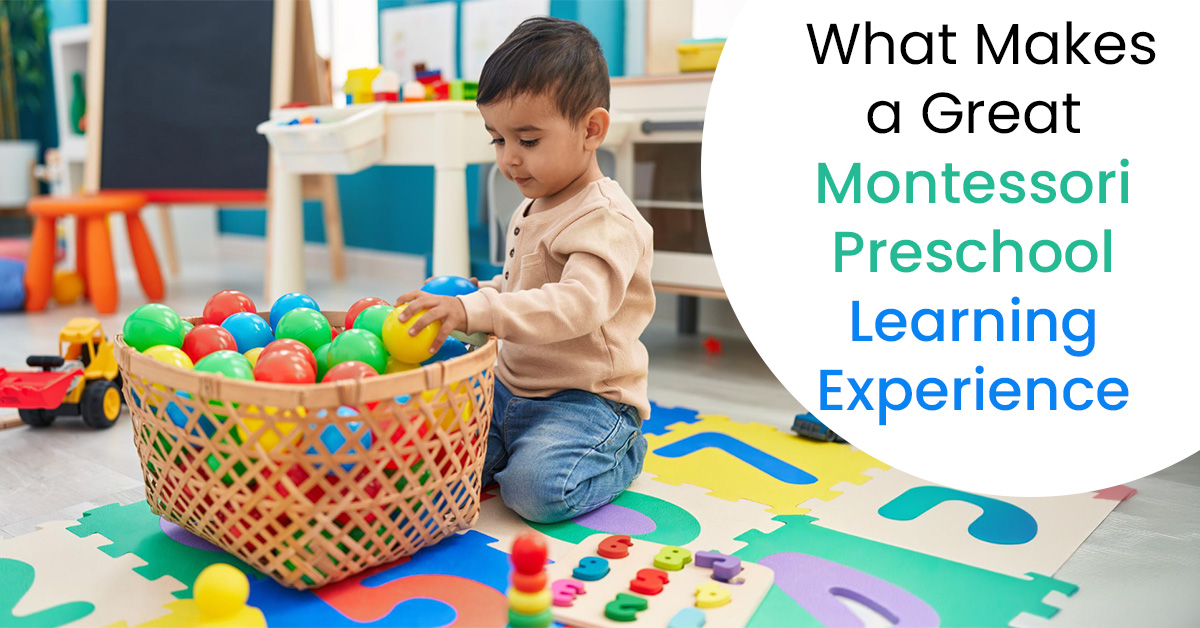
Choosing the right environment for a child’s early years is a heavy decision for any parent. You aren’t just looking for a place where they are supervised; you are looking for a space that respects their innate drive to learn. When evaluating a preschool in Madipakkam, the distinction between a traditional daycare and a true Montessori environment becomes apparent the moment you step through the door. A great Montessori experience isn’t about rigid curriculum or colorful distractions. It is defined by a specific kind of quiet energy: the sound of children who are deeply concentrated on tasks they chose for themselves.
The Prepared Environment is More Than Just Decor
In a standard classroom, the teacher is the focal point. In a great Montessori preschool, the environment is the teacher. Everything is scaled to the child’s physical size. This isn’t just for comfort; it is for autonomy. When a three-year-old can reach the pitcher to pour their own water or take a tray from a low shelf without asking for help, they learn that they are capable. They don’t have to wait for an adult to mediate their basic needs.
A high-quality Montessori space prioritizes:
- Order and Simplicity: Shelves are not cluttered. Every material has a dedicated home, which helps the child build a sense of internal order.
- Beauty and Nature: You’ll see wood, glass, and metal rather than bright primary-colored plastics. Real plants and natural light create a calm atmosphere that invites focus.
- Accessibility: Materials are arranged from left to right, moving from the simplest tasks to the most complex, mirroring the way we eventually learn to read and write.
The “work” available to the child must be purposeful. If the materials are just toys with no specific developmental goal, the essence of the method is lost. A great experience involves “didactic” materials, which are objects that have a “control of error” built into them. This means if a child places a cylinder in the wrong hole of a block, the mistake is visible. They don’t need a teacher to tell them they are wrong because the material provides the feedback. This builds a child’s confidence. They solve their own problems.
The Role of the Guide: Observation Over Instruction
In a Montessori setting, we don’t call the adult a “teacher” in the traditional sense; they are a Guide. Their job is not to stand at a blackboard and lecture. Instead, they move quietly around the room, observing each child’s progress. They know exactly when a child is ready for a new challenge and when to step back and let them struggle productively.
Intervention is a delicate balance. If a child is focused on a task, even if they are doing it “wrong” by adult standards, a great Guide stays away. Interrupting a child’s flow is an interruption of their cognitive development. They only step in when a child is aimless or disruptive. This shift from controlling the class to observing the individual is what allows children to develop at their own pace. You won’t see twenty children doing the same craft at the same time. You will see twenty children doing twenty different things, each tailored to their current developmental “sensitive period.”
Social Dynamics in Mixed-Age Groups
One of the most misunderstood aspects of the Montessori method is the three-year age span. In a great preschool program, you will find children aged three to six working together in the same room. This isn’t a logistical choice; it is a social one. It creates a mini-society that reflects the real world more accurately than age-segregated grades.
The benefits are immediate:
- Peer Teaching: When an older child explains a maths concept to a younger one, they usually understand it better themselves. It also helps them develop patience, confidence, and a stronger sense of responsibility.
- Aspiration: Younger children watch the older ones work with complex materials and are naturally motivated to progress. They see what is possible.
- Stability: A child stays in the same environment with the same Guide for three years. This builds a deep sense of community and security that isn’t possible in schools where children are shuffled to new teachers every ten months.
Discipline in this environment is built through routine and observation, not constant correction. Children pick up behaviour by watching how others move, speak, and handle shared materials. Everyday habits are taught directly, from waiting for a turn to walking around someone’s workspace without interruption. They are also shown how to speak respectfully, ask clearly, and handle small disagreements without shouting or pushing.
Movement and the Mind
Traditional education often treats the body and the mind as separate entities. Children are told to sit still so they can learn. Montessori recognizes that for young children, movement and learning are inseparable. A great Montessori experience allows for freedom of movement. If a child wants to work on the floor, they use a rug. If they want to stand at a table, they do.
This freedom isn’t chaotic. It is a purposeful movement. Practical Life activities, like sweeping the floor, washing dishes, or polishing wood, are the foundation of the preschool experience. While these tasks seem mundane to adults, they are critical for developing fine motor skills, hand-eye coordination, and a long attention span. A child who can carefully carry a heavy glass vase across a room without dropping it is developing the same concentration they will later need for complex geometry or creative writing. They are learning to control their bodies with precision.
Why This Matters for the Future
Education is often viewed as a series of hurdles. Preschool leads to primary school, which leads to university, which leads to a career. This perspective often misses the point of the early years. The habits formed between the ages of three and six are not really about academic benchmarks. They are about the architecture of the mind. A child who spends three years in a Montessori environment learns that their interests have value. They learn how to manage a three-hour work cycle without an adult telling them when to switch tasks. This is the literal definition of executive function.
In the professional world, the most successful individuals are not those who are simply the best at following orders. They are the ones who can identify a gap and fill it. They are the ones who can focus on a complex project until it is finished without needing external validation. Montessori students don’t need a gold star or a sticker to feel successful. The completion of the work is the reward. When you look at preschools in Velachery , you are choosing between a school that produces students and a school that produces thinkers. A great Montessori experience protects the child’s natural curiosity from the pressure of performance. It allows them to fail, to try again, and to eventually succeed on their own terms. This internal drive is the only thing that remains constant in a changing world. It is the difference between a child who survives the educational system and a child who thrives within it.