
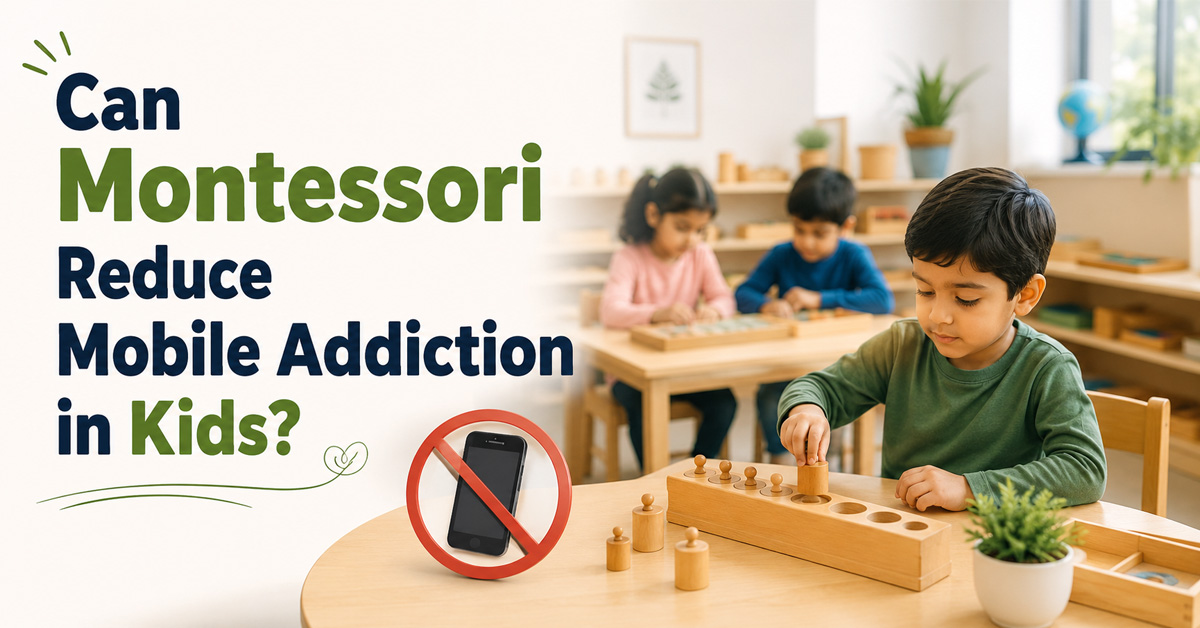
Hand a toddler a phone to keep them quiet for ten minutes, and most parents know exactly what happens next: ten minutes turns into an hour, and the next request comes faster than the last one. Excessive screen time has become the default babysitter in a lot of homes, not because parents don’t care, but because it works in the short term and nobody’s shown them a real alternative. Montessori education is one of the more effective alternatives, and it’s worth understanding why before assuming a “no phone” rule is enough on its own. Parents researching playschools in Velachery often ask this exact question during their first school visit.
Why Kids Reach for Screens So Easily
Screens aren’t inherently the enemy. The problem is what they replace. A few reasons kids gravitate toward them so quickly:
- Instant reward. Videos and games respond immediately, every time, which trains a child’s brain to expect constant stimulation.
- Boredom has nowhere else to go. Without something engaging in reach, a screen is often the only “interesting” object in the room.
- Parents are stretched thin. A screen buys ten quiet minutes when there isn’t time to sit and play something else.
- Passive consumption is easy. Watching requires nothing from the child, while building, sorting, or exploring requires effort.
None of this is a parenting failure. It’s just how easy access plus a busy household plays out. But it does explain why simply removing the phone rarely solves anything unless something else fills that gap.
How Montessori Actually Addresses This
Montessori classrooms are built around the opposite of passive screen use. Instead of a child watching something happen, they’re doing it themselves with their hands, at their own pace, using real materials in front of them.
This matters more than it sounds. A child who spends an hour pouring water, buttoning a frame, or sorting objects by size isn’t just “playing.” They’re building attention span, patience, and the kind of hands-on satisfaction that a screen simply can’t replicate. Over time, this shifts what a child finds engaging in the first place, and excessive screen time starts to lose its pull because it competes with activities that are genuinely more satisfying for a developing brain.
Fine Motor Skill Activities That Compete With Screens
This is where Montessori’s practical life work does the heavy lifting. Fine motor skill activities give children something to do with their hands that is just as engaging as screen time, but focused on real skill development rather than passive watching.
Common examples used in a Montessori setting include:
- Pouring water or rice between containers of different sizes
- Buttoning, zipping, and lacing on dressing frames
- Using tongs or tweezers to transfer small objects
- Threading beads onto string in patterns
- Practising with child-sized tools for sweeping or scooping
These small, repeated actions aren’t filler between “real” lessons. They’re where concentration, coordination, and self-control actually develop, and children who get regular practice with them tend to sit still and focus for longer stretches, on or off a screen.
Where Educational Toys Fit Into the Picture
Not every home can replicate a full Montessori classroom, and that’s fine. This is where the right educational toys make a real difference. Unlike apps designed to hold attention through constant reward loops, well-chosen ones ask a child to think, problem-solve, and complete something with their own hands.
Good options for home use include:
- Wooden puzzles that require actual matching and reasoning
- Stacking and nesting toys that teach size and sequence
- Simple building blocks without lights or sounds
- Shape sorters and knob puzzles for younger toddlers
- Practical life sets like child-safe pouring jugs or lacing cards
The point of educational toys isn’t to keep a child in silence. It’s to give them something worth their attention that also builds a skill. Parents often notice that once these are introduced consistently, requests for the tablet start dropping on their own, simply because the toy holds interest just as long, if not longer.
What Changes When Screens Aren’t the Default
A few patterns show up repeatedly in Montessori-raised children who’ve had limited exposure to excessive screen time from an early age:
- Longer attention spans during hands-on tasks, including reading and drawing.
- Better frustration tolerance, since Montessori materials are designed to let mistakes happen safely.
- Stronger hand-eye coordination from repeated use of fine motor skill activities.
- More independent play, since the child have learnt to occupy themselves without needing constant input.
- Fewer meltdowns when a screen is eventually turned off, because it was never the primary source of stimulation to begin with.
None of this happens overnight, and no single toy or classroom guarantees it. But consistency with hands-on materials, starting young, makes a measurable difference over months rather than days.
How Long Before You Notice a Difference
Parents usually want a timeline, and the honest answer is that it varies by child. Some kids adjust within a couple of weeks, especially younger toddlers who haven’t built years of screen habit yet. Others, particularly children who’ve had unrestricted access for a long time, take longer, sometimes a couple of months of consistent effort, before the pull of a screen genuinely weakens.
What matters more than speed is consistency. A hands-on toy that gets pulled out once and forgotten won’t compete with something designed to be endlessly engaging. But a shelf that’s actually used daily, paired with a parent who resists the easy fallback, tends to shift a child’s habits gradually and permanently rather than through one dramatic change.
Practical Steps Parents Can Start Today
- Put two or three hands-on toys on a low shelf where the child can actually reach them, and swap them out every few weeks. A toy that’s been sitting in the same spot for two months stops being engaging.
- Block off 20 to 30 minutes most days for hands-on play, and resist the urge to hand over the phone the second things get restless. The first five minutes of boredom are usually the hardest part.
- Let kids help with real tasks around the house: pouring water, wiping a table, and matching socks. It doesn’t need to look like a lesson to build the same hand skills.
- Try not to use screens as a reward for good behaviour or as a bribe to get through a tantrum. It teaches a child that the phone is the best stuff and everything else is what you settle for.
- Expect some resistance early on. A child who’s used to constant stimulation isn’t going to sit happily with a puzzle on day one, and that’s normal, not a sign it isn’t working.
Bringing It Together
Montessori doesn’t offer a magic switch that eliminates a child’s interest in phones overnight, but it does offer something screens can’t: a genuine alternative that satisfies the same need for stimulation, just through a child’s own hands instead of a glowing rectangle. Reducing excessive screen time isn’t really about restriction; it’s about replacement, giving a child something more interesting to do with their attention. Between consistent fine motor skill activities, thoughtfully chosen educational toys, and a prepared environment that rewards curiosity, children naturally reach for screens less, not because they’re told to, but because something else has earned their attention instead. Families exploring this approach in person are welcome to visit Play Schools in Adambakkam to see how a Montessori environment actually works before making the switch at home.