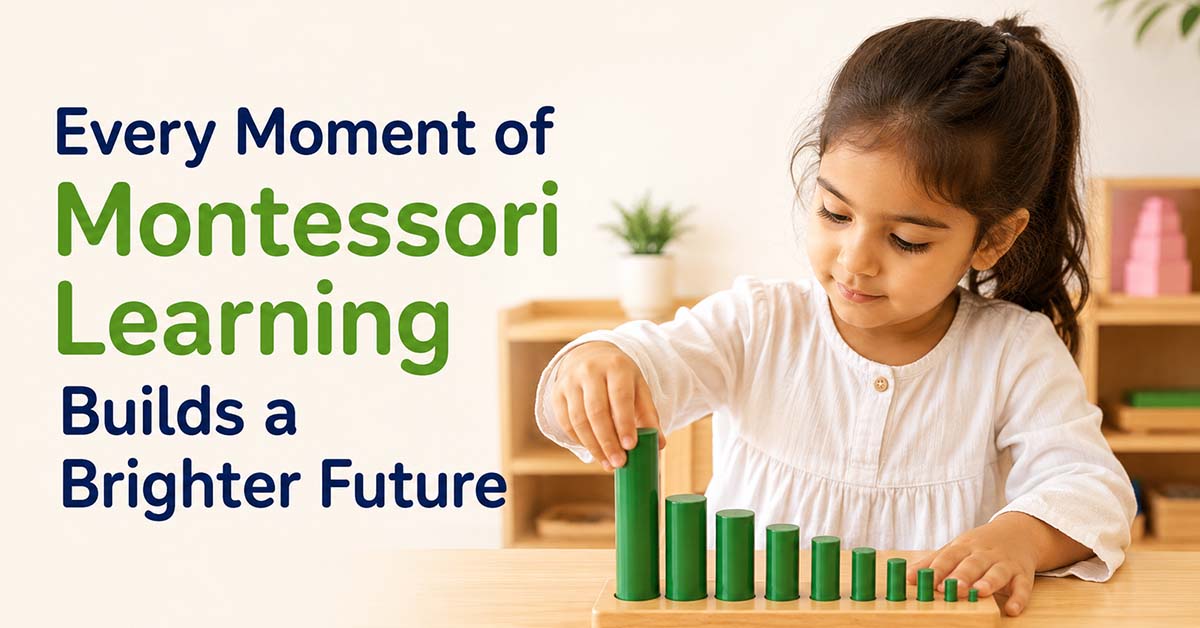
Walk into a Montessori classroom on any ordinary Tuesday, and you won’t find rows of desks or a teacher standing at a whiteboard. You’ll find a three-year-old carefully pouring water from one jug to another, a five-year-old tracing sandpaper letters with her fingertip, and a toddler stacking wooden blocks with the kind of focus most adults reserve for something far more important. None of it looks dramatic. All of it is building something real. This is what early childhood education looks like when it’s designed around how children actually grow, and for families researching a preschool in Madipakkam, understanding this approach makes the choice a lot clearer.
Why the “Ordinary Moments” Matter So Much
Here’s the idea Montessori education is built on, and it’s simpler than most people expect: young children learn best by doing, not by being told. Buttoning a frame, arranging colour tablets, pouring water. None of it looks like “curriculum.” But every piece is chosen because it builds a specific skill, and the child, not the teacher, drives the process.
A few things set this apart from a more traditional setup:
- The child chooses the work. In a prepared environment, kids choose what interests them in the moment. There’s no fixed timetable pushing them from one activity to the next.
- Repetition isn’t a problem, it’s the point. Watch a child pour rice from jug to jug for the tenth straight time and you might assume they’re stuck. They’re not. They’re sharpening coordination and building the kind of concentration that doesn’t come from doing something once.
- Mistakes are expected, even useful. Materials come with built-in “control of error,” so a child can catch their own mistake and fix it, no adult stepping in required.
- Learning doesn’t happen separately from movement. Fine motor skills, sensory work, and cognitive growth aren’t split into different subjects here. They happen at the same time, in the same activity.
Every one of these small, unhurried moments adds up. That’s the whole philosophy in a nutshell: growth doesn’t need to be loud to be significant.
Learning Through Play, Not Learning Versus Play
There’s a common misconception that play and academics sit on opposite ends of a spectrum, that a child is either “playing” or “learning,” never both. Montessori classrooms reject that split entirely. Learning through play isn’t a break from real education here; it is education.
When a child builds a tower with the pink tower blocks, they’re absorbing concepts of size, weight, and sequence long before they’d understand those words in a textbook. When they sort buttons by colour, they’re developing early mathematical thinking. Learning through play, done well, quietly lays the groundwork for skills that formal instruction would take much longer to teach directly.
This matters because young children aren’t wired to sit still and absorb information passively. Their hands are how they think. A well-designed Montessori material turns play into a hands-on, purposeful experience, one where hands-on exploration becomes almost invisible because it feels so natural to the child doing it.
What Self-Directed Learning Actually Looks Like
Self directed learning gets tossed around a lot, but in a Montessori setting it has a very concrete meaning. It’s not children wandering aimlessly around a room. It’s a carefully prepared environment where every material has a purpose, and the child is trusted to choose, focus, and complete work at their own pace.
Here’s what typically supports self directed learning in the classroom:
- A three-hour uninterrupted work cycle, giving children time to deeply engage without being rushed to the next activity
- Materials are arranged on low, accessible shelves so children can select and return work independently
- Mixed-age classrooms, where younger children learn by observing older ones, and older children reinforce their own understanding by helping
- Trained guides who observe closely and step in only when needed, rather than directing every step
The result is a child who develops genuine independence rather than a habit of waiting for instructions. Self directed learning, over time, builds the kind of internal motivation that doesn’t disappear the moment a reward or a teacher’s praise is removed. It’s also why children raised in this environment tend to approach new challenges with curiosity rather than hesitation.
The Long-Term Payoff of Early Childhood Education
It’s easy to think of the preschool years as simply “getting ready” for real school. But early childhood education during this window shapes far more than academic readiness. Between birth and age six, a child’s brain is forming connections faster than at any other point in life, and the environment they’re in during those years has an outsized influence on how those connections form.
Some of what quality early learning builds during this stage:
- Concentration and focus, through work that genuinely interests the child
- Emotional regulation, by allowing children to work through frustration on their own materials rather than being rescued immediately
- Social skills, through mixed-age interaction and community-based classroom routines
- A love of learning itself, rather than learning tied to grades, gold stars, or external pressure
- Independence in daily life, from pouring their own water to managing their own belongings
None of this happens by accident. It happens because this approach to learning, when done thoughtfully, treats the child as capable rather than incapable and gives them real responsibility inside a safe, structured space.
What This Looks Like Day to Day
A typical morning might involve a child washing a table, another threading beads, a third working through a puzzle map of the continents, and a fourth simply observing before choosing their own activity. There’s no bell dictating when one task ends and another begins. The guide moves quietly between children, offering a lesson here and a gentle redirection there, mostly staying out of the way.
Parents sometimes worry that this looks too relaxed, too unstructured, especially compared to more conventional preschools with visible worksheets and structured lesson plans. In practice, the structure is there; it’s just built into the environment and the materials rather than into a rigid schedule. Children thrive on that kind of freedom within limits far more than most people expect. Given time and trust, even children who arrive shy or hesitant tend to settle into a rhythm of their own, choosing work with growing confidence week by week.
Choosing the Right Environment for Your Child
Every family’s situation is different, and location often plays a real role in the decision. For parents based closer to the southern part of the city, a search for reliable options near Velachery often turns up several results, but it’s worth looking closely at how each one actually structures a child’s day. Does the environment genuinely support self-directed exploration, or is it structured activity with a Montessori label attached to it?
A few questions worth asking during a school visit:
- How much of the day is child-led versus teacher-led?
- Are materials genuinely accessible to children, or mostly used in group demonstrations?
- What does a typical work cycle look like, and how long is it uninterrupted?
- How are mixed-age classrooms structured, and how do older and younger children interact?
The answers tell you a lot more than a glossy brochure ever will.
Building a Foundation That Lasts
Every jug poured, every bead threaded, every block stacked and restacked is a small act of construction, not just of a skill, but of a child’s confidence in their own ability to figure things out. That’s the quiet promise behind Montessori education: it doesn’t rush childhood in order to produce results faster. It trusts the process, and the process, over and over, proves itself worth trusting.
If you’re weighing your options and want to see this philosophy in action, whether you’re closer to Madipakkam or exploring playschools in Velachery, the best next step is simple: visit, observe a classroom in session, and watch how the children work. The brighter future this approach promises isn’t built in one dramatic leap. It’s built, quite literally, one ordinary, focused, self-chosen moment at a time.